UdyamGita

The Gita Blueprint for Leading and Winning in Business

UdyamGita

Arjuna Viṣhāda Yoga

Chapter 1 - Verse 1
धृतराष्ट्र उवाच |
धर्मक्षेत्रे कुरुक्षेत्रे समवेता युयुत्सवः |
मामकाः पाण्डवाश्चैव किमकुर्वत सञ्जय ||1||

Translation

Dhrutarashtra said: O Sanjaya! Assembled at Kuru Kshetra, the
designated land for committing righteous acts (Field of Righteousness),
what did my clan of Kauravas and Pandavas do?

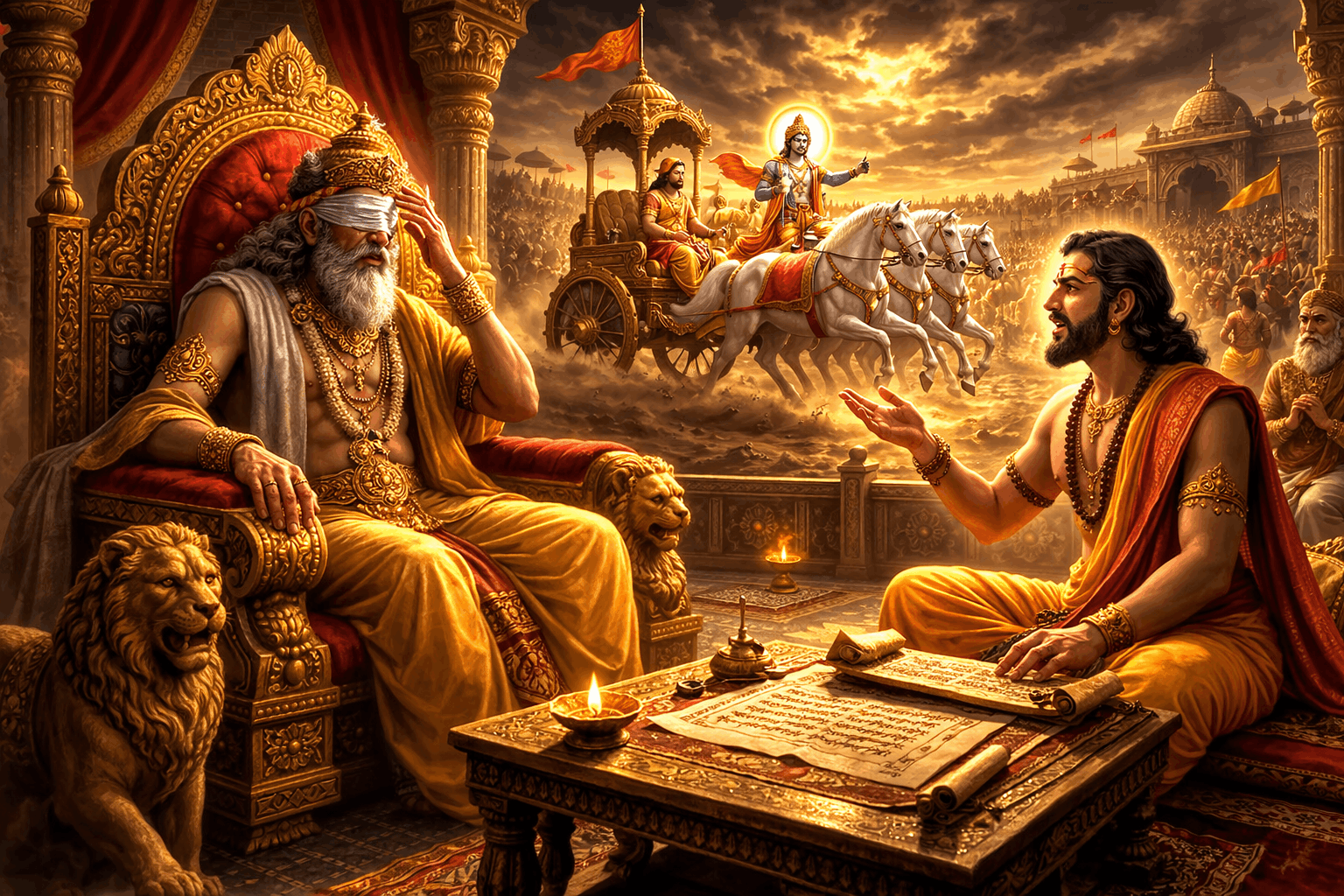
Verse Artwork

Unfiltered First Take

The Gita begins with Dhritarashtra questioning Sanjaya about the events in Kurukshetra. Kurukshetra is also a Dharmakshetra—a place known for uplifting Dharma. Dhritarashtra knows this battlefield will uphold righteousness. While he logically tries to convince himself his sons are in the right, in his heart, he knows the Pandavas are the true upholders of Dharma. He acknowledges the significance of the location and fears it might dampen his sons' dreams, yet he still hopes they will win. The opening line highlights Dhritarashtra's internal dilemma.

He uses the word mamakah, referring to the Kauravas as "his own," subtly categorizing the others as outsiders. As a king, he is presiding over a fight among family and friends. However, by referring to the Kauravas as mamakah, he reveals his partiality toward his sons and their supporters. According to the rules of Raja Dharma, a king should be impartial, protecting the righteous and performing the right Karma.

How is this applicable in business? For a pilot or launch, the "place" (market/context) is crucial. When starting a business, you must choose the right time, place, and fabric. You may allow a competitor to feel comfortable in that space, but you must keep certain "cards" close to your chest. Because Kurukshetra is a Dharmakshetra, Dharma is destined to win—a hidden advantage for the Pandavas. Dhritarashtra’s "blind spot" regarding his sons' actions is ultimately exploited by Krishna and the Pandavas.

By using "mamakah" in a battle of kin, Dhritarashtra signals his bias and lack of commitment to Dharma. When a leader speaks carelessly, employees notice. Most people are observant and catch these slips quickly. For example, in Shloka 13, Sanjaya eventually responds that "your people are scared." While Sanjaya initially ignores the biased phrasing, he eventually mirrors it to reflect the reality of the situation.

As a leader, you must consciously choose your words and avoid careless speech. People around you will not only notice these behaviors but may also use them to revolt or challenge you at the right time. Such behavior negatively impacts a leader's reputation and the overall organizational culture.

UdyamGita Interpretation

The Bhagavad Gita opens not with Krishna’s wisdom, but with Dhritarashtra’s anxiety. He asks Sanjaya about the events unfolding in Kurukshetra—the battlefield chosen for the great war. This is no ordinary land; it is Dharmakshetra, a sacred ground where Dharma is destined to triumph.

Dhritarashtra understands this intellectually, yet he is emotionally unsettled. He knows the Pandavas stand on moral high ground, and that knowledge troubles him. His fear is subtle but profound: Will Dharma tilt the balance against my sons? The very first verse exposes this inner conflict—between what he knows is right and what he desperately wants to win.

His choice of the word “mamaka”my people—is revealing. Though king of the entire Kuru lineage, Dhritarashtra claims only the Kauravas as his own, subconsciously distancing himself from the Pandavas. This single word exposes his partiality and his deviation from Raja Dharma, which demands fairness, justice, and protection of the righteous—irrespective of personal attachment.


Business Insight

Kurukshetra was deliberately chosen as the ground where Dharma would be tested and established. In the same way, entrepreneurship begins with choosing the right battlefield—the right market, timing, ecosystem, and context.

A great idea launched in the wrong environment struggles to survive. Conversely, a well-chosen ecosystem amplifies even an imperfect execution. Early strategic choices quietly but powerfully shape long-term outcomes.

Dhritarashtra’s deeper failure, however, lies elsewhere. He assumes righteousness simply because the Kauravas are his own. This blind spot becomes his greatest weakness. The Pandavas—and Krishna—understand this. They see reality clearly, while Dhritarashtra remains trapped by emotional ownership.

Entrepreneurs often fall into the same trap—defending flawed assumptions, protecting underperforming teams, or clinging to outdated strategies simply because they built them. Businesses rarely fail due to lack of intelligence; they fail due to emotional blindness.


Leadership Lesson

Leadership is revealed not just through decisions, but through language.

Dhritarashtra’s use of “mamaka” subtly exposes his bias. And others notice. Sanjaya initially remains neutral, but later—in Verse 13—he mirrors Dhritarashtra’s phrasing and pointedly says, “Your people are afraid now.” It is a quiet yet powerful reflection of the king’s own words.

In organizations, leaders are constantly being observed. Tone, phrasing, and casual remarks reveal far more than intended. Biased language, careless expressions, or unconscious favoritism erode trust over time. Teams quickly decode these signals and adjust their behavior—often in unhealthy ways.

Strong leaders align their words with fairness, clarity, and integrity. When language is consistent with values, culture becomes resilient. When it is not, credibility quietly collapses.


Key Takeaways

  • Choose your battlefield wisely: Market, timing, and ecosystem can determine success before execution even begins.
  • Bias is a strategic liability: Emotional attachment to people or ideas clouds judgment and weakens leadership.
  • Ownership doesn’t equal righteousness: What is “mine” is not always what is right for the organization.
  • Language reveals leadership: Subtle words expose inner beliefs—teams always notice.
  • Culture mirrors the leader: Inconsistent language and values eventually reflect back as fear, distrust, or disengagement.

Comments & Reviews

Share Your Thoughts

Comments (0)

No comments yet. Be the first to share your thoughts!

Share this Verse