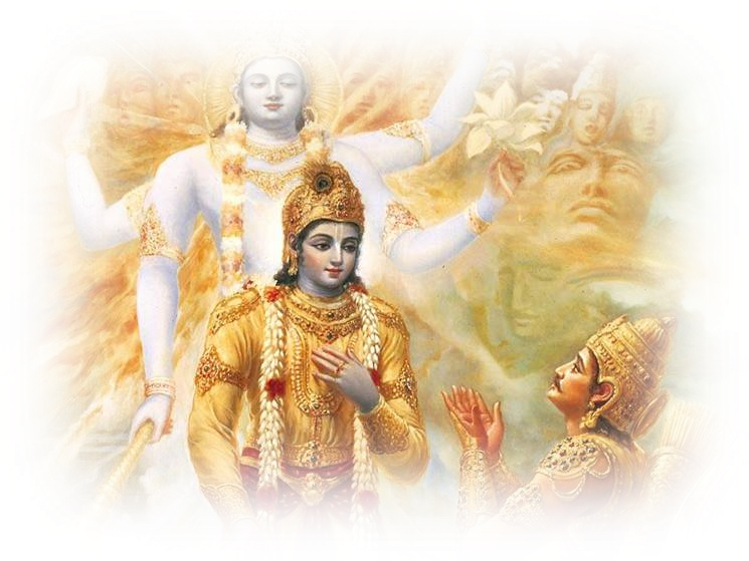
UdyamGita

The Gita Blueprint for Leading and Winning in Business

UdyamGita

Guṇa Traya Vibhāga Yoga

Chapter 14 - Verse 21,22,23,24,25
अर्जुन उवाच |
कैर्लिङ्गैस्त्रीन्गुणानेतानतीतो भवति प्रभो |
किमाचार: कथं चैतांस्त्रीन्गुणानतिवर्तते || 21||
श्रीभगवानुवाच |
प्रकाशं च प्रवृत्तिं च मोहमेव च पाण्डव |
न द्वेष्टि सम्प्रवृत्तानि न निवृत्तानि काङ् क्षति || 22||
उदासीनवदासीनो गुणैर्यो न विचाल्यते |
गुणा वर्तन्त इत्येवं योऽवतिष्ठति नेङ्गते || 23||
समदु:खसुख: स्वस्थ: समलोष्टाश्मकाञ्चन: |
तुल्यप्रियाप्रियो धीरस्तुल्यनिन्दात्मसंस्तुति: || 24||
मानापमानयोस्तुल्यस्तुल्यो मित्रारिपक्षयो: |
सर्वारम्भपरित्यागी गुणातीत: स उच्यते || 25||

Translation

Arjuna said: O Prabhu! What are the traits of people who have
crossed these three qualities? How do they act? How are they able to cross
the three qualities?

The Lord said: O Son of Pandu! One who has transcended the three
qualities of nature (gunas) neither abhors the light of knowledge, activity,
and delusion when they occur, nor craves for them when they cease, OR,
On worldly issues, such people do not despise knowledge (due to sattva),
activity (due to rajas) or ignorance (due to tamas). But on the issue of the
Lord’s attributes, they crave for knowledge (due to sattv) and activity (due
to rajas) and abhor delusion (due to tamas).

They appear to be detached towards most activities even while
indulging in prescribed activities undertaken only to please The Lord. They
are convinced that natural qualities act as per the wishes of the Lord and
cannot act independently. They do not indulge in useless pursuits.

They treat worldly happiness and distress with equanimity. They
look at a piece of gold and a lump of mud the same way. The pleasant and
the unpleasant, and praise and insult, are the same to them.

For such people honour and dishonour, friends, and foes, are the
same. They do not indulge in any worthless activities and focus only on
those activities that please the Lord. They are the ones who have crossed
the three qualities.

Unfiltered First Take

So what are the traits of an entrepreneur who is beyond these gunas and can skillfully play with gunas to get the right results?

They are not bothered by the gunas displayed by people around them. They understand that these gunas are outcomes of past experiences, constraints, egos, and backgrounds. Hence, they focus on utilizing these traits for the benefit of the organization. They neither dismiss people nor keep them away because of their gunas, but instead focus on how to channelize these gunas effectively. They clearly understand people’s behavior and therefore know how to deal with them without getting affected by their reactions.

They remain stable during both difficult and happy times. They are self contained and least bothered about external validation. They do not get deviated by external noise and see everything through a simple lens. If something is useful for the business in any way, it is valuable. If not, they do not even engage with it. They also understand that people praise or blame based on their own perceptions and interests, not always on facts, and may even manipulate facts. Hence, they are not influenced by others’ opinions about them. They are intelligent, well mannered, and do not have permanent friends or foes in the world of business. Thus, they rise above the rest and move ahead of everyone towards their goals and vision.

UdyamGita Interpretation

Arjun now asks the most practical question of all:

What does a person look like who has gone beyond the three guṇas? How do they live, act, and rise above these forces?

Krishna’s answer is subtle and profound. Such a person does not reject sattva, rajas, or tamas—nor do they crave them. They remain steady while the guṇas rise and fall. They understand that it is the guṇas that act, not the true self. Rooted in this awareness, they remain unmoved by praise or blame, gain or loss, honor or insult.

This is not detachment from life.

It is freedom within life.

Business Insight

In entrepreneurship, this teaching defines the highest form of leadership maturity.

A founder who has transcended the guṇas:

  • does not get disturbed by people’s behavior,
  • does not label individuals as “good” or “bad,”
  • and does not take reactions personally.

They clearly see that behaviors are shaped by people’s past experiences, limitations, fears, egos, and conditioning. Instead of resisting these traits, they focus on how to channel them for organizational benefit.

Such leaders don’t waste energy judging people.

They invest energy using human nature intelligently.

Leadership Lesson

The entrepreneur beyond the guṇas is internally unshakeable and externally adaptable.

  • They are stable in success and failure.
  • They are calm in chaos and measured in growth.
  • They are self-contained, not hungry for validation.

External noise—opinions, trends, gossip, praise, criticism—does not pull them off course. Everything is evaluated through a single lens:

“Is this useful for the business and the larger vision?”

If yes, it is valuable.

If not, it does not even register.

They understand that praise and blame are often driven by perception, personal interest, or manipulation of facts. Hence, they do not let public opinion define their self-worth or decision-making.

They are intelligent, composed, and ethical—but emotionally unattached. In business, they hold no permanent friends or enemies. Relationships are dynamic, contextual, and purpose-driven.

This inner neutrality gives them a decisive advantage:

while others react, they respond.

While others oscillate, they advance.

Key Takeaways

  • Transcending the guṇas does not mean rejecting them—it means mastering them.
  • Great entrepreneurs are unaffected by people’s traits but skilled at channeling them.
  • Stability in praise and blame is a non-negotiable leadership trait.
  • External noise loses power when the vision is clear.
  • Those who rise above emotional reactions naturally move ahead of the rest.

Comments & Reviews

Share Your Thoughts

Comments (0)

No comments yet. Be the first to share your thoughts!

Share this Verse