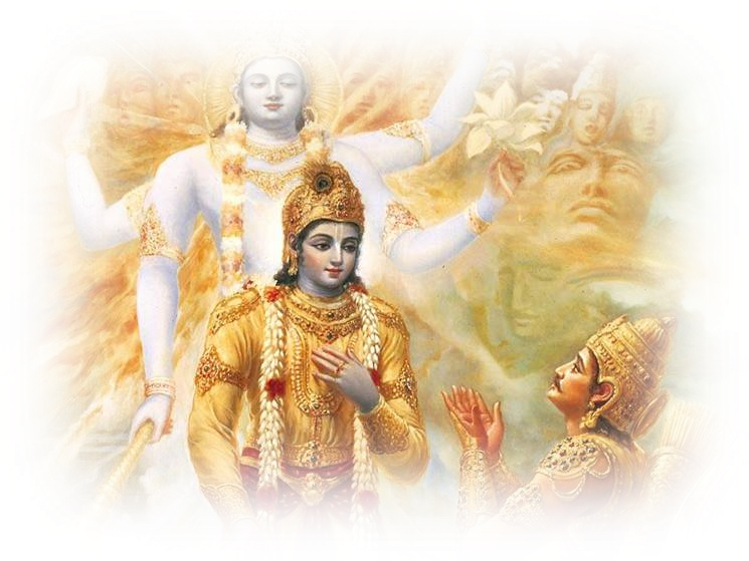
UdyamGita

The Gita Blueprint for Leading and Winning in Business

UdyamGita

Akṣhara Parabrahma Yoga

Chapter 8 - Verse 5,6,7,8,9,10
अन्तकाले च मामेव स्मरन्मुक्त्वा कलेवरम् |
य: प्रयाति स मद्भावं याति नास्त्यत्र संशय: || 5||
यं यं वापि स्मरन्भावं त्यजत्यन्ते कलेवरम् |
तं तमेवैति कौन्तेय सदा तद्भावभावित: || 6||
तस्मात्सर्वेषु कालेषु मामनुस्मर युध्य च |
मय्यर्पितमनोबुद्धिर्मामेवैष्यस्यसंशयम् || 7||
अभ्यासयोगयुक्तेन चेतसा नान्यगामिना |
परमं पुरुषं दिव्यं याति पार्थानुचिन्तयन् || 8||
कविं पुराणमनुशासितार मणोरणीयांसमनुस्मरेद्य: |
सर्वस्य धातारमचिन्त्यरूप मादित्यवर्णं तमस: परस्तात् || 9||
प्रयाणकाले मनसाचलेन भक्त्या युक्तो योगबलेन चैव |
भ्रुवोर्मध्ये प्राणमावेश्य सम्यक् स तं परं पुरुषमुपैति दिव्यम् || 10||

Translation

One who thinks of Me (Krishna) at the time of leaving one’s body
will attain Me. There is no doubt about this.

O son of Kunti! Whatever entity one thinks of at the time of leaving
one’s body, one will attain the same entity (due to the force of habit).

Hence keep thinking about Me (Krishna) always. Perform your duty
of fighting this just war with your mind and intellect focused on Me and
you will certainly attain Me. There is no doubt about this.

O Partha! One who, through rigorous practice of mind control,
withdraws the mind from worldly matters and focuses the mind and the
intellect on the divine, supreme, omnipresent Lord Almighty, will reach the
Lord’s abode.

One should meditate on the Lord Almighty as one who is
omniscient, who is ancient, who governs the entire universe, who is smaller
than the smallest object, who supports and protects everyone and
everything in the universe, who is incomprehensible, who has the radiance
of the sun, and who transcends material nature. One should think of the
Lord, especially during one’s last moments.

One who, at the time of leaving one’s body, meditates on the divine
form of the Lord with utmost devotion, with a focused mind, and holds
one’s life breath in the forehead between the eyebrows, will surely reach
the Lord’s abode.

Unfiltered First Take

Entrepreneurship is not smooth. There are many hurdles, and many times one may reach the point of closing down the business. Even in such situations, if the entrepreneur thinks about the very reason why he started the business and the vision he has, it can greatly help him push boundaries and give it another try by finding even the smallest possible reason, support, or resource available to him and keep the business alive.

The mental state and thought process of the entrepreneur play an important role when such tough situations arise. What he thinks determines what will happen. If he thinks he is tired of fighting it out and that it is better to close the business, he will end up doing that. If he thinks it is better to sell it off to a competitor, he will end up selling it. If he thinks, let me give it another chance, he will find one way or another to try again. When businesses have to transform, they must undergo major makeovers, and many times this is painful. The nature of this makeover depends on the thought process of the entrepreneur.

Hence, it is always better for the entrepreneur to keep reminding himself of the reason why he is running the business and what possibilities he can try to keep it up and running. Without worrying about the outcome, if he focuses on the task at hand and gives his best to execute it, a new pathway to success will definitely open up. Therefore, it is very important for the entrepreneur to keep reminding himself about the vision and mission of the business, possibly in the form of daily meditation.

He should also remind himself of the opportunities his business can bring to him and his people in the system, and how it can make the world a better place. The limitless opportunities for upliftment and empowerment, and the entrepreneurial seeds he is sowing in the minds of people, should motivate him to keep trying, whatever the situation may be. Many times, these challenges arise for expansion, diversification, or realignment required for the business to grow.

UdyamGita Interpretation

Krishna delivers one of the Gita’s most decisive truths: the state of mind at the final moment determines the destination. What occupies consciousness consistently—especially at life’s edge—shapes the future.

Yet, Krishna adds a crucial nuance: this is not about last-minute remembrance alone. It is about a lifetime of practice—training the mind, again and again, to return to the highest focus while continuing one’s duty.

Remember Me, Krishna says—but do your work. Contemplation and action are not opposites; they are allies.

Business Insight

Entrepreneurship is rarely smooth. There are downturns, betrayals, cash crunches, failed pivots, and moments when shutting down feels like the most rational option.

In those moments, what dominates the founder’s mind decides the outcome.

  • If the thought is “I’m exhausted—let’s shut this down”, closure follows.
  • If the thought is “Let me sell this and exit”, an exit appears.
  • If the thought is “Why did I start this—and is there one last way?”, solutions begin to surface.

Just like Krishna’s teaching, the entrepreneur’s dominant thought becomes the next reality.

When businesses transform, the process is painful—restructuring, layoffs, pivots, reinvention. But the quality of transformation is directly proportional to the clarity and steadiness of the founder’s mind.

Leadership Lesson

Krishna emphasizes abhyāsa—practice. Mental discipline is not built in crisis; it is installed long before it.

For an entrepreneur, this means:

  • Repeatedly reconnecting with the original vision
  • Reminding oneself why this business exists
  • Focusing on the task at hand without being paralysed by outcomes

This is where daily reflection or meditation becomes strategic, not spiritual luxury.

When a founder keeps revisiting the mission:

  • New pathways emerge
  • Hidden resources reveal themselves
  • Courage returns—not as emotion, but as clarity

Beyond personal survival, Krishna points to a higher anchor:

Remember the impact—the opportunities created, the people empowered, the entrepreneurial seeds planted in others. Many transformations are not endings but preparations for expansion, diversification, or realignment.

Key Takeaways

  • Your dominant thought in crisis becomes your next decision
  • Mindset precedes strategy; clarity precedes courage
  • Transformation pain is shaped by the founder’s inner state
  • Focus on execution, not outcome—paths reveal themselves
  • Daily remembrance of vision is a leadership discipline

Comments & Reviews

Share Your Thoughts

Comments (0)

No comments yet. Be the first to share your thoughts!

Share this Verse